Most people shopping for a home charger compare chargers. The product is the cheap, simple part. The expensive and uncertain part is usually somewhere else entirely: the electrical panel on the garage wall, and whether it has room for a new load that will run for hours at a time.
Understanding what that question means makes quotes easier to compare and conversations easier to follow. To be clear at the outset, assessing a home’s electrical capacity is a job for a licensed electrician, and nothing here is instruction for doing it yourself. The aim is to explain what the electrician is looking at and why.
In brief
- The panel, not the charger, usually decides the cost.
- A load calculation estimates headroom using code methods and is the electrician’s job.
- Tight capacity still has options: lower output, load management, a subpanel, or a panel or service upgrade.
In this guide
What the panel is, and what limits it
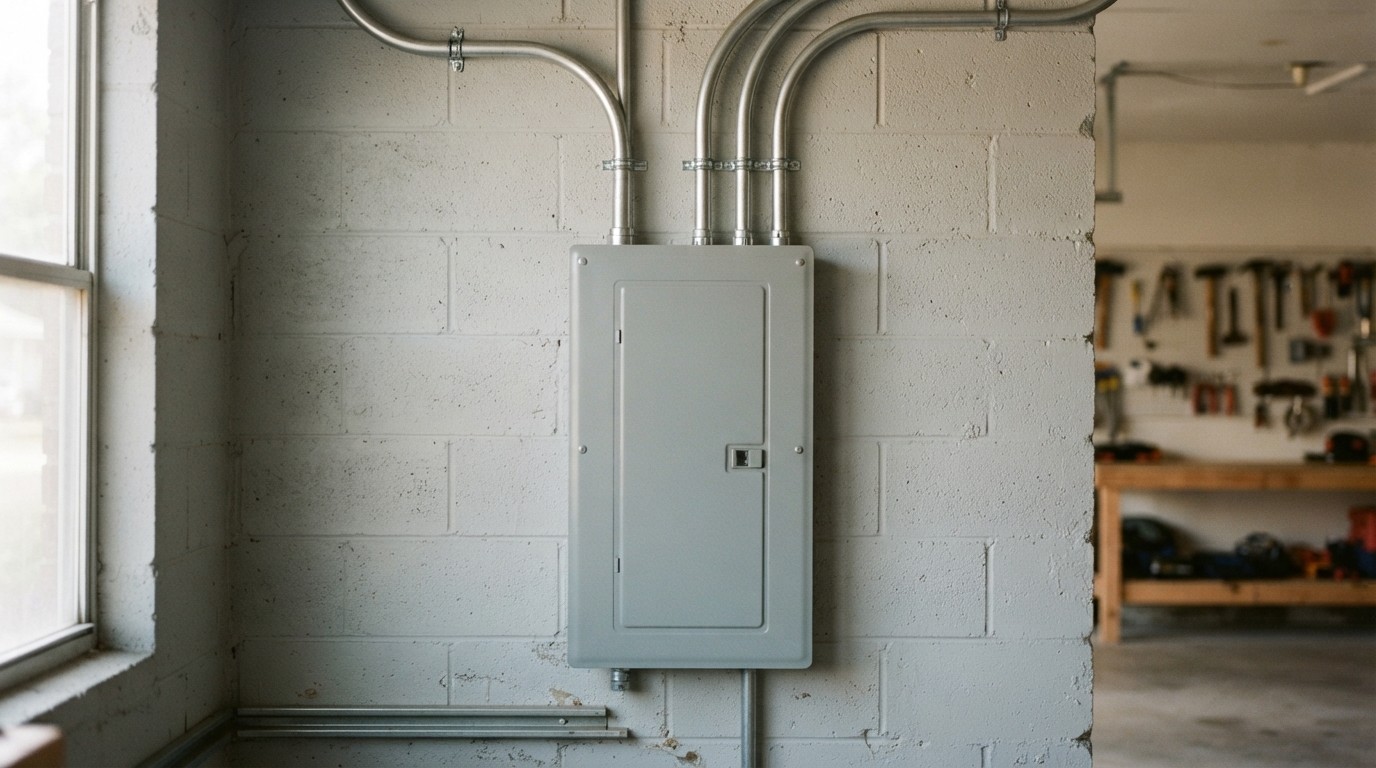
Electricity enters the house through a service and arrives at the main panel, which divides it into branch circuits for the kitchen, the lights, the air conditioning, and so on. Two limits matter.
The first is the service size: the maximum amount of current the whole house can draw. It is a rating, usually marked on the main breaker, and homes are commonly served at a range of sizes. Older and smaller homes often have smaller services, and larger or newer ones tend to have more.
The second is space and condition within the panel: whether it has a free slot for another breaker, and whether the panel itself is in good shape and suitable for the work.
An electric vehicle charger adds a large load that can run for hours, which is more demanding than most household uses. Cooking, laundry and air conditioning tend to run in bursts, while charging runs continuously for long periods. Electrical rules treat long-running loads specially, because sustained current heats components differently from short bursts. The rules, and how they are applied, are set locally and change, so your electrician applies the code that governs your area.

What a load calculation does
To decide whether a home can take a charger, an electrician performs what is called a load calculation. It is a structured way of estimating the home’s demand, using methods set out in the electrical code, and comparing it with what the service can supply.
In outline, the electrician considers:
- The size of the home, since lighting and general loads are estimated from floor area.
- Large fixed appliances: electric range, clothes dryer, water heater, air conditioning, heat pump, electric heating, pool equipment, a hot tub.
- Any other large additions, such as a workshop or a second dwelling unit.
- The size of the service and the condition of the panel.
- The charger’s proposed output, since a larger charger uses more of the available capacity.
The result is a view of how much headroom remains. Two homes with the same service size can have very different answers: one with gas heating, a gas range and a small air conditioner has plenty of headroom, and another that is all-electric may have none.
A calculation is only as good as its inputs. It is an estimate based on code methods, not a measurement of what you actually use, and in some cases the electrician may use actual recorded usage where the rules allow. What it provides is a defensible basis for saying yes, no, or yes with conditions.
What else the electrician checks
- Space for a breaker. A panel with no free slots may need rearranging or a subpanel.
- The condition of the panel. Age, signs of overheating, corrosion or damage, and whether it is of a type with known concerns. An old panel may need replacing before new load is added.
- Grounding and bonding. Whether the existing installation meets current standards.
- The distance from the panel to the charger. A long run requires heavier conductors, which costs more.
- The route. Through finished walls, across a ceiling, along a basement, or outside. Difficult routes add labour.
- The location. Garage, carport or outdoors, with different requirements for weather protection.
Options when capacity is tight
A finding of limited capacity is not a dead end. Electricians commonly have several ways to proceed, and the right one depends on your home and your budget.
| Option | What it involves | Considerations |
|---|---|---|
| Install a lower-output charger | Choose equipment that draws less, or set a charger’s output to a lower level | Slower charging, but often enough overnight; the cheapest route |
| Load management device | Equipment that monitors the home’s total demand and limits the charger when other loads are high | Can avoid an upgrade; needs to be approved by your electrician and, where required, accepted locally |
| Reduce other load | Replace or reschedule a large appliance | A trade-off with the home’s other uses |
| Add a subpanel | A secondary panel near the garage fed from the main | Solves space and distance issues; does not create extra service capacity on its own |
| Upgrade the panel | Replace the main panel with a modern one with more spaces | Solves condition and space problems; may or may not increase service capacity |
| Upgrade the service | Increase the capacity delivered to the house, involving the utility | Most expensive and slowest; involves the utility’s schedule |
Be wary of anyone who proposes a major upgrade without doing a calculation, and equally of anyone who promises that a panel will be fine without looking at it. The honest answer comes from the numbers for your house.
Your utility and your permit
Two outside parties are often involved.
The utility controls the service to your home. If a service upgrade is needed, it requires the utility’s participation, scheduling and sometimes its approval. Some utilities also have rules or notification requirements for installing a charger, or offer special rates and programmes for electric vehicle owners. Ask what applies in your area. We do not state any specific rate or incentive, because they change and differ between utilities.
The building department issues permits and inspects the work. In most places, installing a charging circuit requires a permit and an inspection, and a licensed electrician will normally pull it. An unpermitted installation can cause problems with your insurer and when you sell the home.
What you can do before the electrician arrives
- Find out your vehicle’s maximum home charging rate from the manual, so the charger is not oversized.
- Note what large electrical appliances you have, and which of them are electric rather than gas.
- Take photographs of the panel, with its door open, if you are comfortable doing so. Do not remove covers or touch anything inside. Opening the cover that protects the wiring is the electrician’s job.
- Locate the likely charger position and measure roughly how far it is from the panel.
- Check whether you rent, belong to an association, or live in a multi-unit building, since permission may be needed.
- Get more than one quote, and ask each electrician to show how they assessed capacity.
Questions to ask each electrician
- Did you perform a load calculation for my home, and can I see the result?
- What is the size of my service, and how much headroom does it leave?
- Is my panel suitable for added load, or does it need work?
- What charger output are you proposing, and why?
- Would a load management approach avoid an upgrade, and is it acceptable here?
- Who pulls the permit, and who schedules the inspection?
- What happens if the inspector requires changes?
- What does the quote include and exclude?
A good electrician will welcome these questions. The answers will tell you whether your charger is a simple afternoon’s work or the start of a larger project, and that is the thing worth knowing before you buy the equipment.
What to do next
- Find your car’s maximum home charging rate in the owner’s manual.
- Photograph the closed panel door and note which large appliances are electric.
- Get two quotes and ask each electrician to show their load calculation.