People usually decide where to put a charger by looking at the wall and choosing the spot that seems convenient. That works often enough, but it ignores three things that make a poorly chosen location annoying for years: where the car’s charging port actually is, how far the cable has to stretch, and how far the electrician has to run wire from the panel.
A little planning before the installer arrives avoids most of the regrets. This guide covers what to measure and what to consider.
Short answer: choose the spot from where your car’s charging port really is, add margin to the cable reach, keep the wire run to the panel short, and plan for a second car before the wall is closed.
In this guide
Start with the car, not the wall
Charging ports are in different places on different vehicles: front corner, rear corner, either side, or behind the front grille. The cable has to reach it from the charger, and you will park in a slightly different position each time.
- Find your car’s port and note which side and which end it is on.
- Park as you normally do, in your usual position, and note how consistent you are. If you park a few feet differently each day, the cable needs more slack.
- Measure from the likely mounting spot to the port, following the path the cable will actually take, not a straight line. Cables hang and curve.
- Check the cable length of the charger you are considering. Charging cables commonly come in a range of lengths, and a longer cable gives more freedom.
- Add margin. A cable that only just reaches is tense and awkward, and wears out faster.
- Think about your next car. It may have a port on the other side, and a mounting position that suits both cars with a longer cable is more flexible than one that suits only today’s.
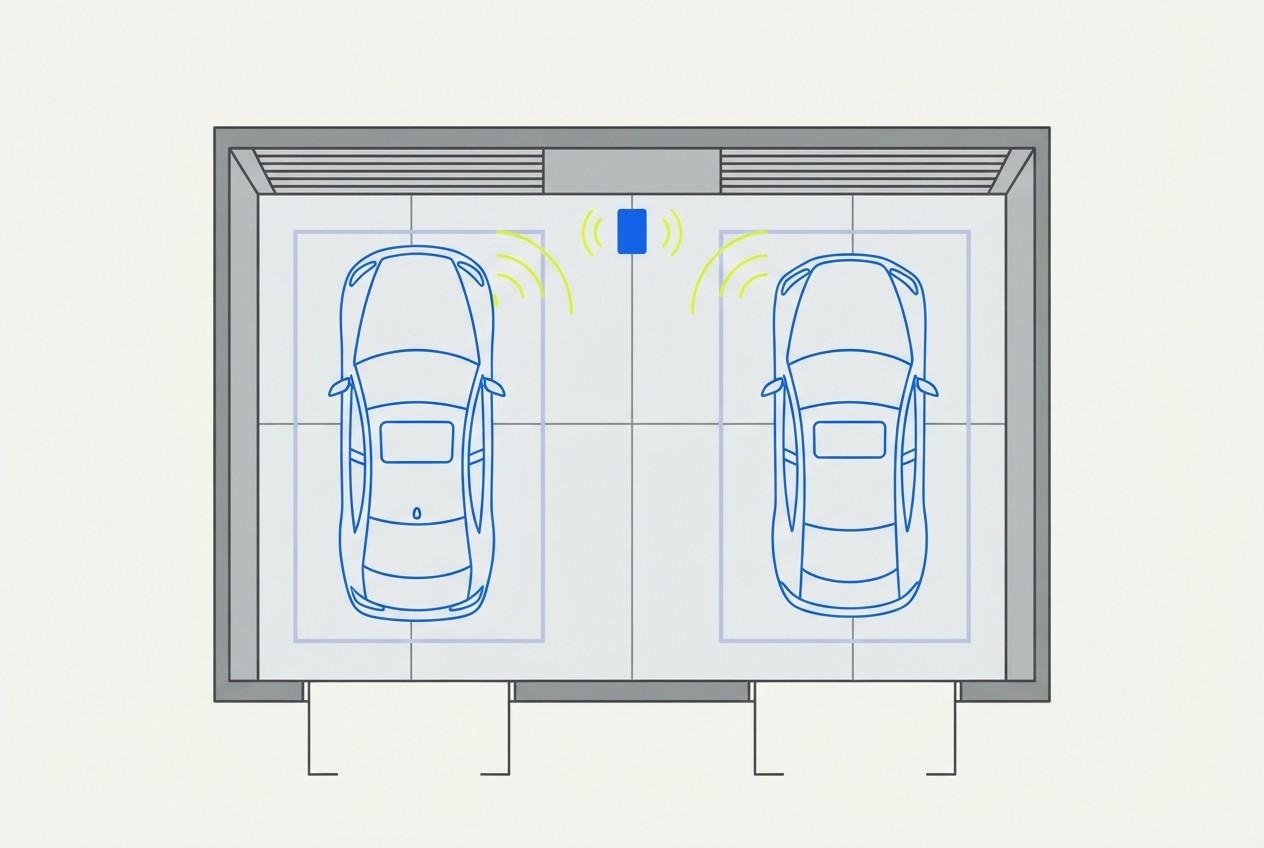
Garage, carport or driveway
| Location | Advantages | Things to consider |
|---|---|---|
| Inside the garage | Protected from weather; usually close to the panel; theft and tampering are less likely | Needs enough room to park and open doors; cable has to reach the port when the car is parked in its usual spot |
| Carport | Partly sheltered; usually near the house | Open to wind and blowing rain; check the equipment’s weather rating; consider theft |
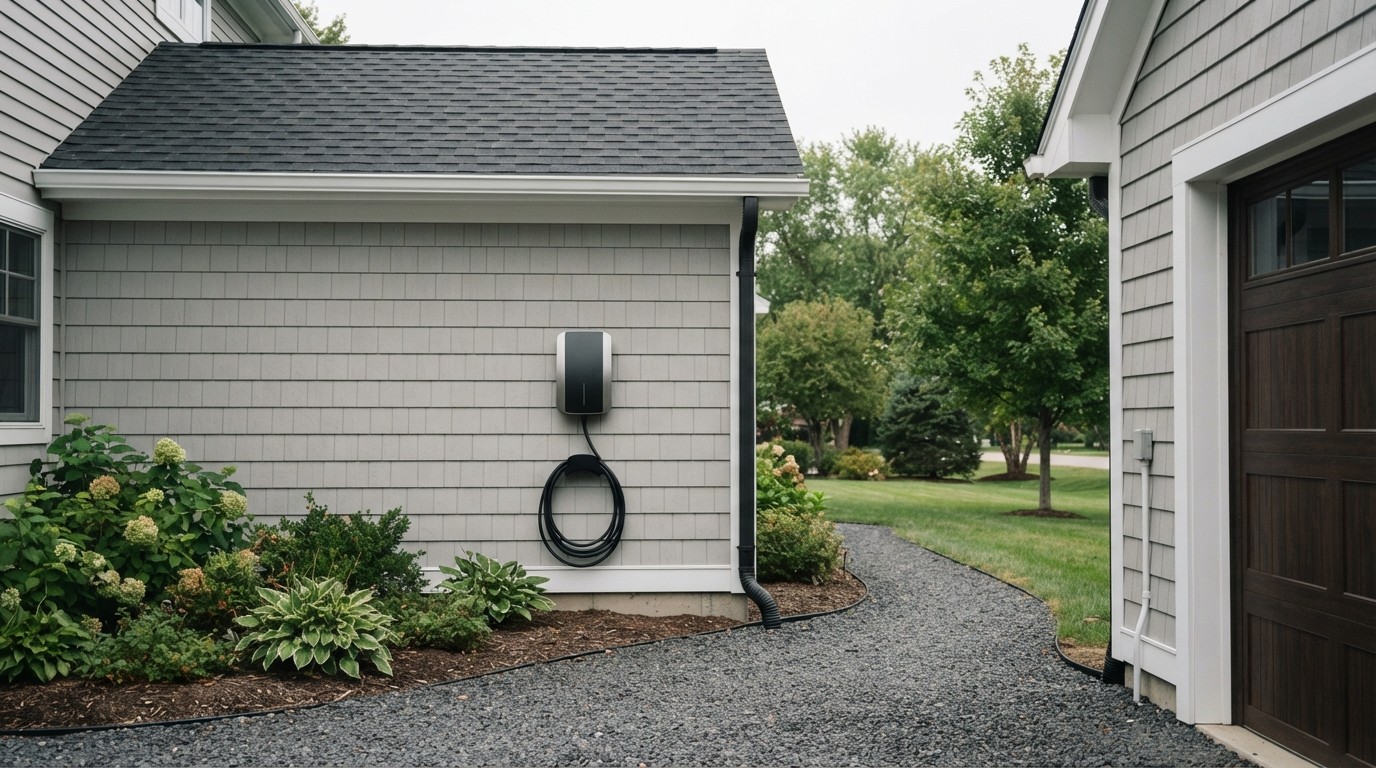
| Exterior wall by the driveway | Works when there is no garage; easy to reach | Fully exposed to weather and sun; needs a suitably rated unit; wiring may need to run through or around the house |
| Freestanding post | Useful where there is no suitable wall, such as a detached parking area | Requires trenching and a post; more complex and costly; subject to local rules |
| Detached garage | Convenient for the parking | A longer wire run from the main panel, which affects cost; sometimes needs a subpanel |
Distance from the panel affects cost
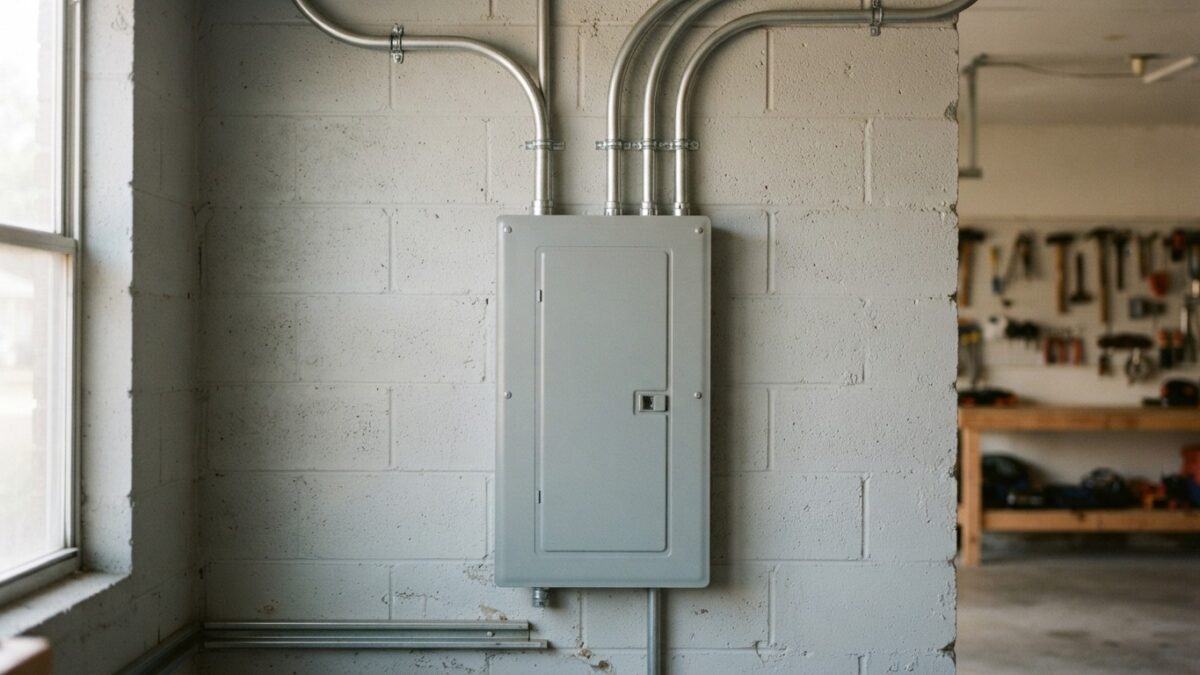
One of the biggest drivers of installation cost is the length of wire between the panel and the charger. A charger on the wall right beside the panel is the simplest installation. A charger at the far end of a long garage, in another part of the house, or in a detached building needs a longer run, heavier conductors for a long distance, and more labour.
The route matters as much as the distance. Running wire through an open garage wall is quick. Running it through finished rooms, across a ceiling, or through a concrete wall is slow. An outside run may need conduit, and an underground run needs trenching.
It is worth asking the electrician to price at least two locations. A spot that is slightly less convenient for the cable but much closer to the panel can be noticeably cheaper, and a slightly longer cable can be a better buy than a long wire run.
All of this work belongs to a licensed electrician, with permits and inspection. We describe the factors so that you can discuss them, and we do not give any wiring instruction.
Weather and the environment
- Rating. Chargers carry an enclosure rating describing protection against dust and water. An outdoor installation needs a unit rated for outdoor use and for the climate, and an electrician will confirm what the local code requires.
- Temperature extremes. Very hot or very cold locations affect equipment and cables. Check the operating temperature range in the specification.
- Direct sun and snow. Sunlight can heat a unit and degrade the cable, and snow can bury a low-mounted one. Mounting height and some shelter help.
- Water. Avoid places where water pools or where sprinklers hit the unit.
- Salt and corrosion. Coastal locations need attention to corrosion resistance.
Mounting height and cable management
Mount the charger at a height that is comfortable to reach and keeps the connector off the ground when stored. Many owners choose a height that puts the unit within easy reach of an adult and the cable’s resting point at a comfortable level. The manufacturer’s instructions and local requirements may specify a range, and your installer will follow them.
Provide a place to hang the connector and coil the cable when not in use. Cables left on the floor get driven over, trodden on, and soaked in rain, which damages them and is a trip hazard. Many chargers include a holster or hook, and a wall-mounted cable hanger is inexpensive.
Keep the cable away from where you walk, and where children and pets play, and do not stretch it across a path. Do not use damaged cables. If the cable or connector is cracked, frayed or discoloured, stop using it and contact the manufacturer or an electrician.
Planning for a second car
Many households start with one electric vehicle and end up with two. Thinking about it at the installation stage is much cheaper than retrofitting.
- Position the first charger so it can serve either bay, perhaps between two parking spaces, if the cable length allows.
- Ask the electrician about future capacity. Could the circuit or the panel support a second charger later, or share the load between two with a management device?
- Consider running extra conduit now. Installing an empty conduit while a wall is open costs little and makes a later circuit easier.
- Check the panel space. Leave room for a second breaker.
Other practical considerations
- Wi-Fi. A connected charger needs a signal. Check the strength where you plan to mount it, particularly in a detached garage or an exterior wall, and tell the installer if it is weak.
- Lighting. Charging happens at night. A well-lit position is safer and more convenient.
- Garage door and clearance. Make sure the charger does not interfere with the door, its tracks, or a vehicle’s doors and bumper. Allow room to walk around the car.
- Other uses of the space. Work benches, storage and a second car all compete for the wall.
- Parking guides. A mark or stop on the floor helps you park in the same spot each time, which keeps the cable reach consistent.
- Renting or shared parking. If you rent, or live in a condominium or an association, you may need written permission before installing anything, and there may be rules about where chargers can go and who pays. Ask before you buy.
A planning checklist
- Where is the charging port on this car, and on the next one you might own?
- What is the distance from the usual parking position to the proposed mounting spot, along the cable’s real path?
- How far is the spot from the electrical panel, and what is the route?
- Is the location protected enough for the unit’s rating?
- Is there somewhere to hang the cable, and is the area well lit?
- Is the wall solid enough, and clear of obstructions, doors and storage?
- Does the location suit a second charger later?
- Is the Wi-Fi signal adequate, if the charger is connected?
- Do you need permission from a landlord or an association?
Take photographs of the garage and the proposed location, with measurements, and share them with the electrician before the visit. Ask them to confirm the position on site and to explain how the wiring will reach it. A few minutes of preparation produces a charger that is easy to use and does not cost more to install than it needs to.
Frequently asked questions
How long should the charging cable be?
Long enough to reach the port from your usual parking position along the cable’s real path, with some slack. Cables come in a range of lengths, so check before buying.
Can the charger go outdoors?
Yes, if the unit is rated for outdoor use and the installation meets local code, which your electrician will confirm.
Is it worth running extra conduit for a second charger?
Often, if the wall is already open, because it costs little then and saves opening it again. Ask your electrician.